
On competitive bodybuilding, the pursuit of excellence, and learning not to lose yourself in the process.
KEY TAKEAWAYS
Ambition without dependence: Pursue victory wholeheartedly, but don't let the result determine your worth.
Immersion, not drowning: Love bodybuilding, commit deeply to it, but don't allow it to become your entire identity.
Control what you can: Your preparation is your responsibility. Your placing is never entirely within your control.
Defeat isn't automatically growth: Losing doesn't make you wiser. How you respond to it might.
Character beyond the stage: Winning is worth pursuing, but humility in victory and grace in defeat are achievements of their own.
Picture this...
You're standing at the back of the stage.
The last fifteen minutes have been spent attempting to effortlessly display every sinew of striated muscle on your exhausted body, to a panel of judges whose faces you can barely see, and a crowd of people you can only hear.
The last six months have been spent working towards this singular moment.
The hunger. The sleepless nights. The debilitating fatigue in the face of having to lift heavy weights to the point of even more exhaustion. The endless cardio sessions, the arduous posing practice, the constant scrutiny of your physique in the mirror.
The relationships placed on hold, the occasions missed, the job performance that may have left your superiors wanting.
All the sacrifices.
All for this moment.
The room falls silent as the emcee takes the microphone.
"In fifth place..."
Nope, not my name.
"In fourth place..."
Still not me. Hell yeah, top three!
"In third place, competitor number..."
You glance down at your number to double-check.
Holy shit. Top two.
“And in second place, please take the silver medal to competitor…”
Your heart beat permeates the room…
“…number…”
Ba-boom…ba-boom…ba-boom…
“362!”
Your number.
Wait.
Your number?
You've come second.
Are they sure?
You stand there, smiling for the cameras, shaking hands, congratulating the winner, while somewhere inside your head, an entire universe begins collapsing.
Six months of work.
Debilitating hunger.
Years of training.
And for what?
A silver medal?
Welcome to competitive bodybuilding.
The peculiar cruelty of competitive bodybuilding
There's something rather unusual about bodybuilding as a competitive pursuit.
In most sports, the result is determined by a relatively objective measure.
This person lifted more weight than that person.
That person ran faster than this person.
This team scored more points than that team.
Of course, there are exceptions. Plenty of sports involve subjective officiating, and the idea that every athletic contest produces an indisputably correct result is a little naïve.
But bodybuilding is particularly interesting because the very thing we're attempting to achieve — the ideal physique — is evaluated through human judgement.
There are established judging criteria: muscularity, conditioning, symmetry, proportion, presentation. These aren't arbitrary concepts, and competent judges can make well-reasoned assessments of the physiques in front of them.
Nevertheless, there's an unavoidable element of individual interpretation.
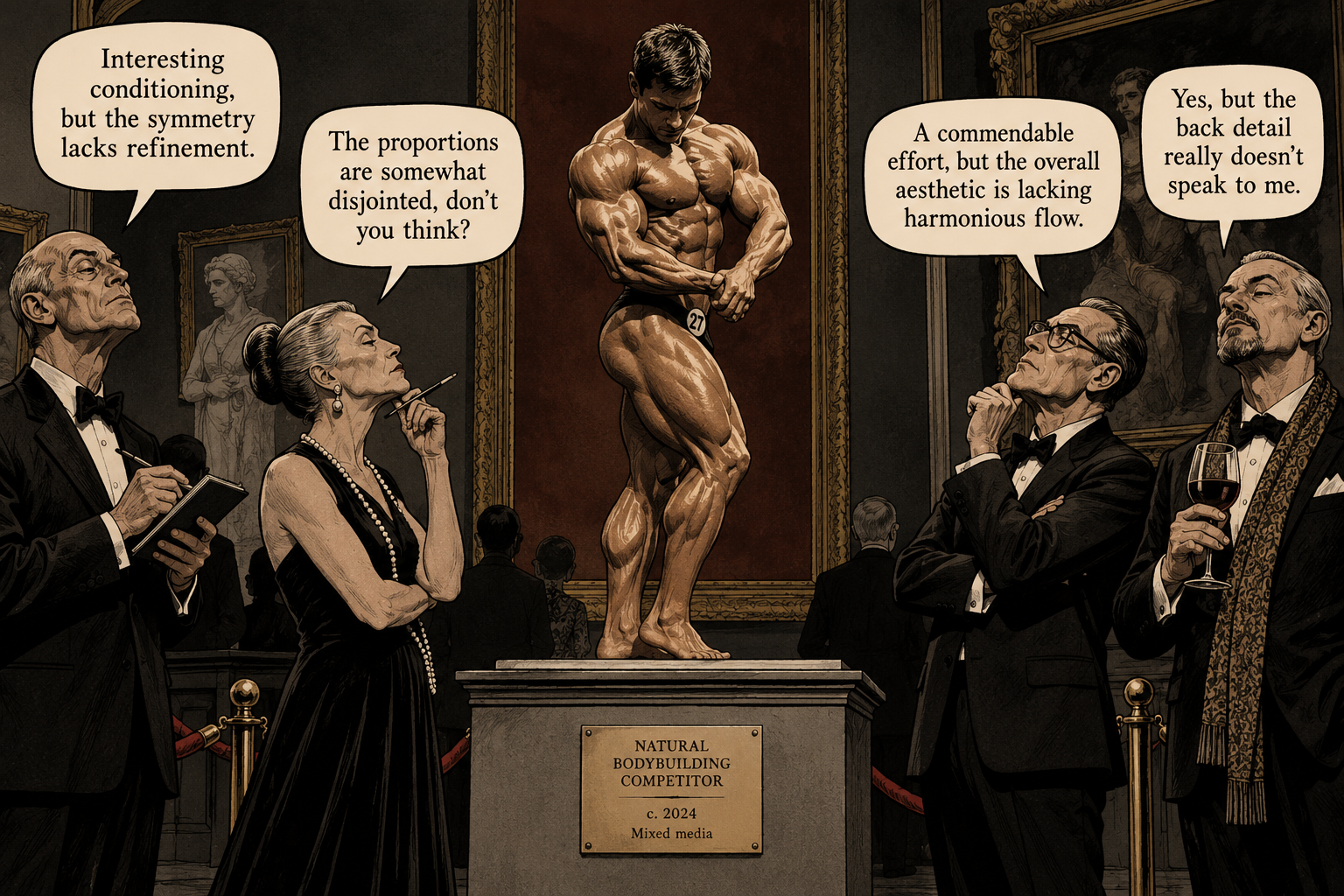
The subjective nature of Bodybuilding.
And then there's the small matter of who actually turns up on the day.
You could bring the greatest physique you've ever presented, having made improvements across every conceivable measure, only to discover that someone else has brought something better.
Or you could arrive in worse condition than your previous competition and win because the standard of the line-up happens to be lower.
I've experienced both sides of that equation.
It's like trying to hit a moving target when you're not entirely sure where the bloody thing is going to be in the first place.
Now, that's not to suggest judging is meaningless, or that we should dismiss results whenever they don't go our way. If a panel of experienced judges consistently places another competitor ahead of you, there may well be something worth learning from that.
But it does present an interesting problem.
If your definition of success is determined exclusively by your placing, then your sense of accomplishment is, at least partly, at the mercy of circumstances outside your control.
You can influence the outcome.
But you cannot guarantee it.
And if you aren't careful, this can become a rather unpleasant psychological arrangement.
The defeat of victory
As with most things, I had to learn this the hard way.
In 2009, I competed in my first bodybuilding season.
My first show was a state championship, where I won my category against a sizeable lineup of competitors. I think there were about fifteen of us, back when men's bodybuilding was essentially just... bodybuilding.
Naturally, being young, enthusiastic, and with no shortage of smoke being blown up my arse, I went to the National Championships expecting to win again.
I came second.
And it damn near ended me.
I was staying alone in Melbourne at the time, and in an attempt to soothe my thoroughly deflated sense of self, I embarked on an impressive eating spree.
After months of dieting, the sudden abundance of food seemed like a reasonable solution.
It wasn't.
I spent much of that night unable to sleep thanks to the indigestion, and returned home to Sydney inconsolable and, frankly, utterly horrible to be around.
I'd love to tell you this was the only time I behaved that way after a disappointing competition result.
It wasn't.
Looking back, the problem wasn't that I wanted to win.
The problem was that somewhere along the way, winning had become entangled with my sense of personal worth.
The last two years of my own therapeutic journey have helped me understand that a fair bit of this may have started long before I ever picked up a dumbbell, back when I was a young lil' “Fat Red” (a pseudonym I adopted during my illustrious ten-minute career as a competitive eater).
Being chubby, freckly and red-headed made me a fairly convenient target for bullying. I mean, can you blame them? That's PRIME bully-target material.
Jokes aside, the constant finger-pointing and ridicule left their mark.
And something I've come to recognise is that those early successes in bodybuilding weren't simply about winning competitions. They helped me reclaim a sense of confidence, acceptance and personal power that I'd felt deprived of long before I had much say in the matter.

UNLIMITED POWER? The Fat Red vs. The Johnny Bravo Challenge at Johnny Bird in Crows Nest, Sydney — was this just me trying to get back power I’d lost?
Image courtesy of the Mosman Daily
So when I lost, perhaps it wasn't just the competition result that hurt.
Perhaps, on some level, I was experiencing a threat to something bodybuilding had helped me rebuild.
Which is rather interesting when you consider how much of our behaviour can be influenced by experiences we never chose to have in the first place. Another reminder that we're not quite as independent of circumstances as we'd sometimes like to believe.
What I’ve since learned is that I'd interpreted that second-place result as evidence that I wasn't who I thought I was - quite a remarkable amount of psychological significance to place on the outcome of a competition involving fake tan, very small underpants, and a group of unusually muscular people.
But there it was.
And I suspect I'm not the only bodybuilder who's experienced something similar.
When defeat becomes fuel
Something interesting happened after that competition.
With a full belly and the accompanying sense of guilt, I did what any self-respecting Roman Philosopher-King would do (talking 'bout you, Marcus)...
I decided to put that bitter defeat to use.
What stood in the way would become the way.
I hung my second-place medal in the bathroom, where I'd see it every morning, as a reminder.
Fuel for the fire.
For the next couple of weeks, I trained with an almost obsessive determination to improve. I wanted to beat the competitor who had beaten me at Nationals.
And, as fate would have it, I did.
At the Natural Olympia, held in Australia that year, I finished third in a larger international line-up, competing in the junior category despite having competed as a teenager earlier that season.
I was pretty bloody happy with that.
I finished third behind Australian natural bodybuilding legend Nathan Wallace, and the walking mitochondria that is Benny Wortley (a quick google of Benny in contest shape will make readily apparent why I give him that title).
Not bad company.
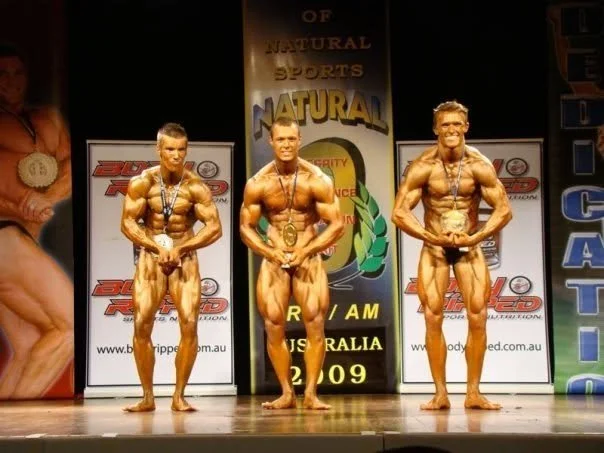
Chuffed, on the far right.
But here's the interesting part.
Was that result really the consequence of those two weeks of furious determination?
Certainly, my efforts may have contributed to improvements in my presentation and performance.
But do you REALLY think I'd somehow transformed my physique in a fortnight?
Of course not.
The line-up was different. The circumstances were different. The competitive standard and comparisons were different.
And yet, I had been tempted to interpret one result as evidence of my inadequacy and the other as vindication of my efforts.
Both interpretations placed far too much importance on the result itself.
There's another uncomfortable truth here.
Although I'd successfully turned disappointment into motivation, I hadn't necessarily addressed the underlying problem.
I was still relying on an external outcome to restore something I felt I'd lost.
And that is where I think the real opportunity for growth begins.
The difference between ambition and dependence
Let's be clear about something.
I don't believe bodybuilders should stop caring about winning.
Quite the opposite.
Competition provides a standard against which we can test ourselves. It encourages us to pursue levels of development we might otherwise never attempt.
There's something deeply satisfying about preparing for a competition with the intention of bringing the best physique you're capable of presenting, and there's nothing wrong with wanting that effort to be recognised.
But I think we need to distinguish between two very different relationships with success.
The first is ambition.
I want to win because I love this pursuit, I want to test myself against excellent competitors, and I want to discover what I'm capable of.
The second is dependence.
I need to win because without that result, I won't feel good enough.
The behaviours associated with these motivations can look remarkably similar from the outside.
Both athletes might train hard, eat meticulously, practice posing and make significant sacrifices.
But the internal experience can be very different.
For one athlete, competition is an opportunity to express something they value.
For the other, competition has become a test of their personal worth.
And the trouble with the second arrangement is that there is never any guarantee of satisfaction.
Even victory can become a temporary reprieve before the next standard presents itself.
Another title.
Another competitor.
Another physique that makes yours look inadequate.
Another reason to believe you haven't quite done enough.
It's an exhausting way to live.
And, having spent a fair bit of time living that way myself, I can't say I'd recommend it.
Immersion, not drowning
I love bodybuilding.
I love the process of developing a physique. The technical demands of training. The discipline required to prepare for competition. The satisfaction of making improvements that can take months or years to become visible.
I also appreciate what the pursuit has taught me about patience, humility, self-awareness and personal responsibility.
But bodybuilding is not the entirety of who I am, and I think this is something worth remembering, particularly during contest preparation.
When you're deep into a diet, exhausted, hungry, and your brain is functioning with all the sophistication of a bowl of cold soup, it's easy for bodybuilding to feel like the centre of the universe.
For a time, it might occupy an extraordinary amount of your attention - that's not necessarily a problem. Serious pursuits demand serious commitment.
But there's a difference between immersing yourself in something meaningful and allowing it to consume your entire identity.
Immersion, not drowning.
The distinction matters because the more narrowly we define ourselves, the more vulnerable we can become when something threatens that identity.
If being a successful bodybuilder is the only thing that makes you feel worthwhile, what happens when you lose?
What happens when you're injured?
When progress stalls?
When life inevitably gets in the way?
When someone with better genetics, more muscle, or a more favourable structure steps onto the stage beside you?
What happens when, despite doing everything reasonably within your power, the result simply doesn't go your way?
If bodybuilding is something you do, love and take pride in, these experiences can be deeply disappointing.
But if bodybuilding is all you believe yourself to be, they can feel devastating.
And again, I don't think the answer is to become less committed.
I think it's to develop a broader and more secure sense of who we are, so that we can commit wholeheartedly without becoming dependent on the outcome.
Not detached from outcome - INDEPENDANT of it.
And no, I'm not suggesting you need to take up pottery, learn interpretive dance, or suddenly become the world's most attentive dinner-party guest (although, depending on how you've behaved during your last contest prep, that final option might not be a terrible idea).
The point is simply that the person underneath the tan and the muscle is worth developing too. An arsehole with a trophy is still an arsehole.
The problem with borrowed standards
There's another dimension to this, particularly in an age where so much of bodybuilding is experienced through social media.
We're constantly exposed to other people's physiques, achievements, opinions and definitions of success.
Some of this can be genuinely useful.
Seeing an exceptional athlete can inspire us to reconsider what's possible. Observing someone else's development can provide valuable lessons. Sharing achievements can foster community and connection.
But there's a danger in allowing these external standards to become the primary measure of our own lives.
Because there will always be someone bigger.
Someone leaner.
Someone stronger.
Someone with a better structure, a more impressive competitive record.
And if our sense of accomplishment depends on measuring favourably against everyone else, we're volunteering for a competition that never ends.
Social media hasn't invented our fascination with status, appearance or social approval. Humans have been concerning themselves with those things for rather a long time.
It has, however, given us an extraordinarily efficient means of comparing ourselves with an almost endless supply of other people.
Which is fantastic…
… if your ambition is to never feel quite satisfied with anything you've achieved.
This doesn't mean we should reject external standards - competitive bodybuilding requires them. We need to understand what excellence looks like within our chosen division, and we should be willing to receive honest feedback when we fall short.
But the standards used to evaluate our competitive performance need not become the standards by which we evaluate our worth as human beings.
They're not the same thing.
One concerns how well we performed within a particular athletic pursuit.
The other concerns something considerably larger. Confusing the two is where much of the unnecessary suffering begins.
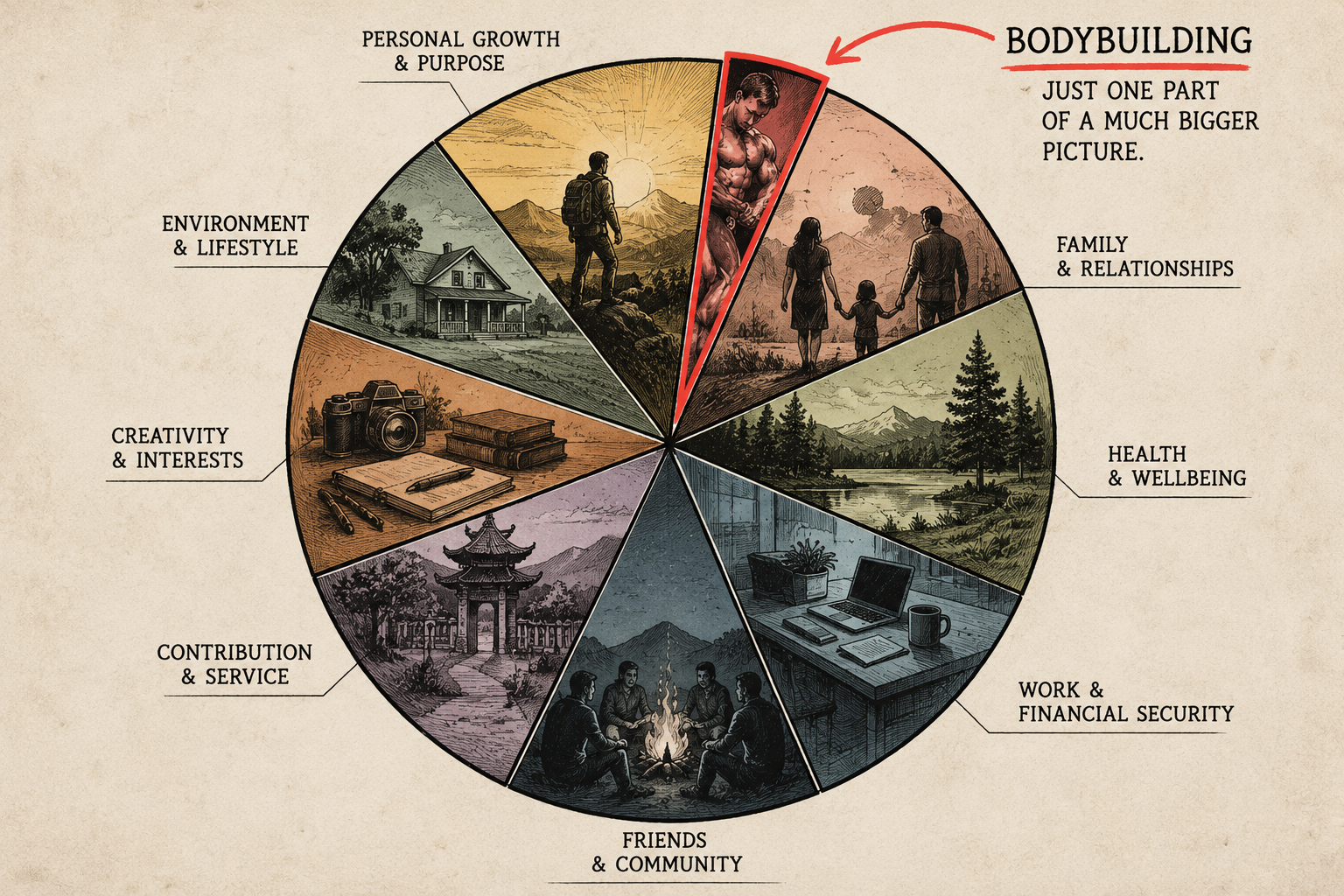
The Wheel of Life, adapted for the consummate bodybuilder
Never discount the element of luck
Here's something else that I think deserves consideration.
We like to imagine ourselves as entirely self-made creatures; that our achievements are the direct consequence of our effort, discipline, intelligence and determination.
And while those things certainly matter, there's a rather inconvenient variable we tend to overlook:
Luck.
You had no say in the genetics you were born with.
You didn't choose your skeletal structure, muscle insertions, or natural capacity to develop muscle.
You didn't choose the circumstances of your birth, the environment you grew up in, or the opportunities that were available to you.
Even the fact that you're sitting here reading an article about competitive bodybuilding, rather than worrying about where your next meal is coming from, reflects circumstances that extend well beyond your individual efforts.
This isn't an argument against personal responsibility.
Quite the opposite.
I think recognising the influence of circumstances can make us more appreciative of the opportunities we have, and more humble about the achievements we enjoy.
In bodybuilding, genetics matter enormously.
So does the quality of your training, your nutrition, your recovery, your coaching, your consistency, and the decisions you make over years.
Both things can be true.
You can take enormous pride in the work you've done while recognising that your success was never entirely yours to manufacture.
And when you lose, you can acknowledge your shortcomings without assuming the result is a complete reflection of your personal merit.
That, to me, seems a considerably more balanced way of approaching competition.
What defeat can actually teach us
It's tempting to romanticise defeat; to suggest that hardship automatically makes us stronger, wiser, more disciplined or more deserving of success.
But I don't think that's entirely true. Defeat can just as easily make us bitter.
It can encourage resentment, unhealthy comparison, reckless training decisions or an obsession with proving other people wrong.
I know this because I've experienced some of those reactions myself. Actually, scratch that - I've experienced ALL of those reactions.
Pain doesn't automatically produce wisdom. It's what we do with the experience that matters.
And sometimes, what we need to do is considerably less glamorous than launching ourselves into another punishing training block.
Sometimes we need to acknowledge that we're disappointed.
To question why a particular result affected us so deeply.
To consider whether our expectations were realistic.
To listen to criticism without interpreting it as a personal attack.
To recognise where we genuinely fell short, and where circumstances were simply outside our control.
And occasionally, to accept that the healthiest decision might be to step away for a while.
None of this is particularly exciting. It doesn't make for a very impressive motivational video.
But I suspect it's considerably more useful than convincing ourselves that every setback must immediately be converted into another opportunity to work harder.
Working your arse off for the sake of working your arse off generally achieves one thing: working your arse off (although admittedly, in the context of contest prep, quite literally working your arse off is par for the course).
And whilst effort is certainly necessary, blindly applying more of it isn't always the solution.
It's a bit like trying to cook a roast chicken by cranking the oven to its highest setting because you want dinner sooner. Sure, you'll probably get something resembling a cooked chicken. But it'll also have the texture of old boot leather.
Sometimes the better result comes from respecting the process, applying the appropriate amount of effort, and having the patience to let things develop.
(Heston Blumenthal's rather elaborate approach to roasting a chicken springs to mind. Although, in fairness, I suspect most bodybuilders would struggle to justify spending two days preparing a meal they're going to inhale in approximately four minutes.)
The point is: there's a time to push.
And there's also a time to reflect, recover and exercise restraint.
And learning to distinguish between the two is part of becoming a better athlete.
A different kind of victory
I've spent a great deal of time thinking about what I'd like to achieve in my next competitive season.
Naturally, I want to present the best physique I've ever built.
I want to compete against excellent bodybuilders.
I want to win.
To etch my name in the annals of history as “The best looking bloke in dick stickers at this particular time on this particular day”.
But there's another goal I'm increasingly interested in pursuing. One that has considerably less to do with the judges and genetic anomalies.
I want to become the kind of athlete who can pursue victory wholeheartedly without allowing the result to determine how I feel about myself.
Now, my original inclination was to describe this as becoming unfazed by my placing. But the more I've reflected on it, the more I think that misses the point.
Why shouldn't I be disappointed if I lose?
I've invested an extraordinary amount of time, money and effort into bodybuilding.
Hell, I moved to the country, bought a house big enough to accommodate my own fully equipped gym, and have structured much of my life around optimising training proficiency and recovery.
Of course the result matters to me!
But there's a difference between something mattering deeply and allowing it to determine your worth.
I want to be able to stand on stage, hear my placing, and respond with the maturity the occasion deserves.
If I win, I want to enjoy it without allowing the result to inflate my sense of importance.
If I lose, I want to acknowledge the disappointment, congratulate those who performed better, and consider what I can learn.
And when the competition is over, I want to return to the other parts of my life with the same appreciation I had before stepping on stage.
That is a different kind of achievement. One that can't be awarded by a judging panel.
Of course, I can't guarantee that I'll respond perfectly. Given my history, that would be a rather ambitious claim.
But I can work on it.
Through reflection, through challenging my own assumptions, through therapy when it's useful, and through continuing to expose myself to situations where the outcome matters to me but isn't entirely within my control.
I suspect this will require considerably more effort than lifting weights and getting my cardio done.
And unlike a bodybuilding competition, there won't be anyone handing out medals for it.
Which, now that I think about it, is probably rather fitting.
The victory of defeat
Competitive bodybuilding offers us something remarkable.
An opportunity to pursue physical excellence through years of disciplined effort, to challenge ourselves against others who share that ambition, and to discover aspects of our character that might otherwise remain unexplored.
But the pursuit becomes far more rewarding when we learn to distinguish between what we can influence and what we cannot control.
We can prepare diligently, develop our physiques, improve our posing, refine our training, manage our nutrition, and arrive on stage having done everything reasonably within our power.
We cannot determine who else turns up.
We cannot guarantee how the judges will evaluate us.
And we cannot ensure that our efforts will produce the result we desire.
What we can do is develop a relationship with bodybuilding that allows us to find meaning in the pursuit itself.
To appreciate the process of becoming better.
To welcome excellent competition rather than resent it.
To celebrate victory without arrogance, and experience defeat without surrendering our self-respect.
And perhaps most importantly, to recognise that bodybuilding, for all its demands and rewards, is one part of a much larger life.
The stage can tell you where you placed on a particular day.
It cannot tell you what your years of effort were worth.
It cannot tell you whether you've become a better person.
And it certainly cannot tell you who you are.
That remains your responsibility.
So by all means, pursue excellence. Welcome the challenge. Give everything you reasonably can.
But don't lose yourself in the process.
Because the greatest victory bodybuilding can offer might have very little to do with winning shows.
And sometimes, defeat gives us the opportunity to discover that.
Shugyo Bodybuilding Coaching
I work with natural Open and Classic bodybuilders who are committed to long-term development — not simply their next competition.
My approach considers the athlete as a whole: training, nutrition, preparation, recovery, and the mental and emotional demands of pursuing excellence.
If that approach resonates with you, you're welcome to learn more about my coaching.
